
Keynote Address
Computing Futures: Challenges and Opportunities
Abstract: If there is any enduring lesson in computing, it is the constancy of change, some predictable and some deeply disruptive, that repeatedly reshapes the status quo. Today’s computing ecosystem is in extraordinary flux, with profound implications for research and discovery, economic competitiveness, and national security. From the geopolitics of semiconductor foundries, their exponentially rising costs, and the slowing of Moore’s Law through the rise of cloud hyperscalers and shifting loci of economic leverage to the profound and still uncertain effects of deep learning and AI, the future promises to be qualitatively different from the past.
Navigating this uncertainty will likely require new technical approaches and different mindsets. This talk will draw some perspectives from the history of computing and offer some thoughts on possible futures shaped by technology – semiconductors, AI, biology, mathematics, and software – and shaped by geopolitical policy and economics. Finally, overlaying these technical and economic issues are equally important questions of policy, law, and ethics in a world being radically reshaped. This talk will discuss lessons I have learned over the past fifty years and offer some possible insights for the future.
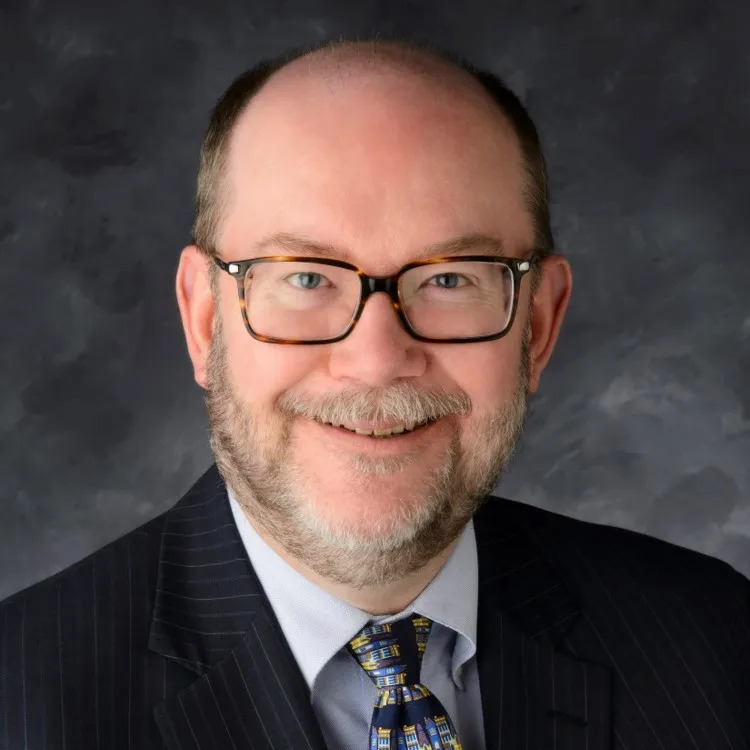
Daniel A. Reed
Daniel A. Reed is Presidential Professor of Computational Science (emeritus) at the University of Utah. Throughout his career, he has held influential leadership roles in high-performance computing, research cyberinfrastructure, and U.S. science and technology policy. Dr. Reed most recently served as Senior Vice President for Academic Affairs (Provost) at the University of Utah. Earlier, he served as Vice President for Research and Economic Development at the University of Iowa, founding director of the Renaissance Computing Institute (RENCI) at the University of North Carolina at Chapel Hill, Director of the National Center for Supercomputing Applications (NCSA), and Corporate Vice President for Technology Policy and Extreme Computing at Microsoft, where he helped shape the company’s long-term vision for cloud computing and technology policy. At NCSA, he was one of the principal investigators and chief architect for the NSF TeraGrid, the pioneering national cyberinfrastructure that evolved into XSEDE and today’s ACCESS program.
Dr. Reed has also played a prominent role in U.S. science and technology policy. He recently completed his service as chair of the U.S. National Science Board, the governing body that provides oversight for the National Science Foundation, and previously chaired the Department of Energy’s Advanced Scientific Computing Advisory Committee. His leadership has helped advance research computing and scientific infrastructure at both the national and institutional levels. He is a Fellow of the ACM, IEEE, and AAAS.
Still Have Questions?
Call us at 773.795.2667
Email us at events@rcc.uchicago.edu